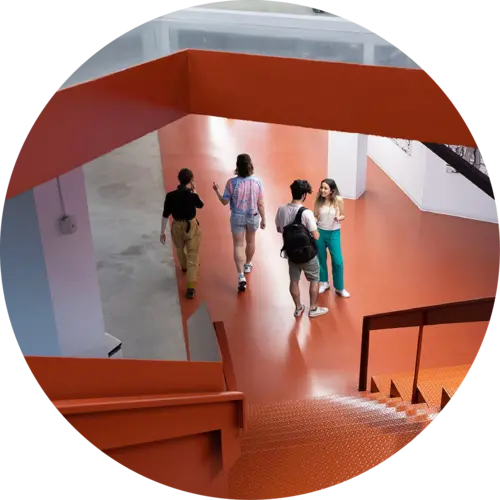
Join us on June 10 for the "After Mila" event, a series of community meetups pairing AI researchers with field experts to discuss the tangible impact of AI on our daily lives.
The Mila AI Policy Fellowship translates deep AI expertise into rigorous, public-interest policy. Read the newest publication Bridging the Expertise Gap: Knowledge Transfer Mechanisms for AI Regulation by Moritz von Knebel
We use cookies to analyze the browsing and usage of our website and to personalize your experience. You can disable these technologies at any time, but this may limit certain functionalities of the site. Read our Privacy Policy for more information.
Setting cookies
You can enable and disable the types of cookies you wish to accept. However certain choices you make could affect the services offered on our sites (e.g. suggestions, personalised ads, etc.).
Essential cookies
These cookies are necessary for the operation of the site and cannot be deactivated. (Still active)
Analytics cookies
Do you accept the use of cookies to measure the audience of our sites?
Multimedia Player
Do you accept the use of cookies to display and allow you to watch the video content hosted by our partners (YouTube, etc.)?
Sim-to-real transfer of locomotion policies often leads to performance degradation due to the inevitable sim-to-real gap. Naively fine-tunin… (see more)g these policies directly on hardware is problematic, as it poses risks of mechanical failure and suffers from high sample inefficiency. In this paper, we address the challenge of safely and efficiently fine-tuning reinforcement learning (RL) policies for dynamic locomotion tasks. Specifically, we focus on fine-tuning policies learned in simulation directly on hardware, while explicitly enforcing safety constraints. In doing so, we introduce SLowRL, a framework that combines Low-Rank Adaptation (LoRA) with training-time safety enforcement via a recovery policy. We evaluate our method both in simulation and on a real Unitree Go2 quadruped robot for jump and trot tasks. Experimental results show that our method achieves a