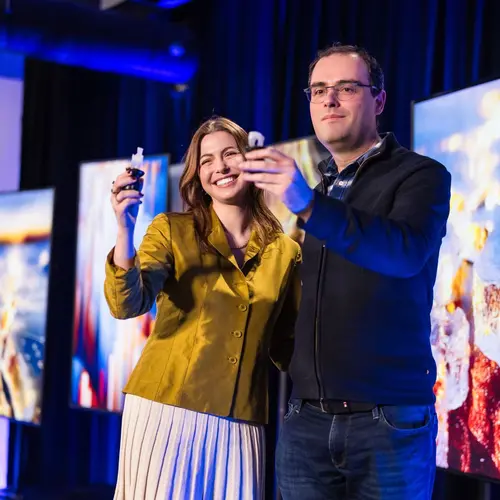
Join us on June 10 for the "After Mila" event, a series of community meetups pairing AI researchers with field experts to discuss the tangible impact of AI on our daily lives.
The Mila AI Policy Fellowship translates deep AI expertise into rigorous, public-interest policy. Read the newest publication Bridging the Expertise Gap: Knowledge Transfer Mechanisms for AI Regulation by Moritz von Knebel
We use cookies to analyze the browsing and usage of our website and to personalize your experience. You can disable these technologies at any time, but this may limit certain functionalities of the site. Read our Privacy Policy for more information.
Setting cookies
You can enable and disable the types of cookies you wish to accept. However certain choices you make could affect the services offered on our sites (e.g. suggestions, personalised ads, etc.).
Essential cookies
These cookies are necessary for the operation of the site and cannot be deactivated. (Still active)
Analytics cookies
Do you accept the use of cookies to measure the audience of our sites?
Multimedia Player
Do you accept the use of cookies to display and allow you to watch the video content hosted by our partners (YouTube, etc.)?
With the latest advances in deep learning, several methods have been investigated for optimal learning settings in scenarios where the data … (see more)stream is continuous over time. However, training sparse networks in such settings has often been overlooked. In this paper, we explore the problem of training a neural network with a target sparsity in a particular case of online learning: the anytime learning at macroscale paradigm (ALMA). We propose a novel way of progressive pruning, referred to as \textit{Anytime Progressive Pruning} (APP); the proposed approach significantly outperforms the baseline dense and Anytime OSP models across multiple architectures and datasets under short, moderate, and long-sequence training. Our method, for example, shows an improvement in accuracy of